
In late 2025, the program and communication teams of Berks County Community Foundation spent two days in the Kutztown area. There, they visited local institutions that contribute to the area’s vitality.
The foundation conducts these site visits to gain knowledge about the communities we serve. Some institutions have received gifts from various funds the foundation manages. Other institutions simply enrich the cultural, educational, or religious life of the county.
This blog post is part two of a two-part series on the Kutztown tour. Read part one, available here.
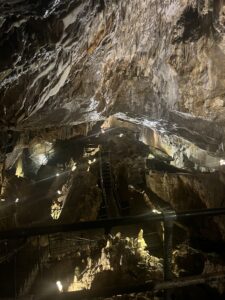
The second half of the Kutztown site visit started one cold November morning at Crystal Cave, one of the oldest tourist landmarks in Berks County. Discovered on November 12, 1871, our team toured the first “show cave” in Pennsylvania on the 154th anniversary of the cave’s discovery.
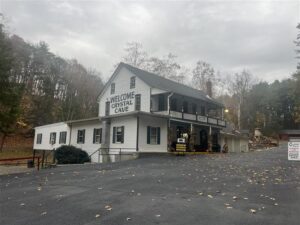
The cave was discovered by William Merkel and John Gehret while they were blasting for limestone. After the smoke cleared, the pair descended 125 feet into damp, underground darkness. Although the pair didn’t come to purchase the cave, their initials are etched into one of the cave’s rock formations. With some formations aging more than half a million years old, it is safe to say that Merkel and Gehret’s legacies will endure for generations to come.
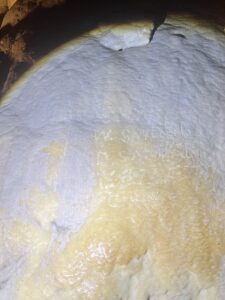
Human influence—and intrusion—are common traits in Crystal Cave’s history as a “show cave”. Immediately after Merkel and Gehret’s discovery, Berks County residents began to brave the impenetrable darkness of the cave, in search of souvenirs. Frustrated with the damage, Samuel D. F. Kohler bought the cave, built an official entrance, and started charging guests 25 cents for admission.
The ancient appeal of Crystal Cave brought tourists from all over the country, which ushered in a time of economic growth for Kohler. Improvements were made inside the cave for safety purposes, a hotel was built for guests, and a stagecoach was purchased to expand access across the region.
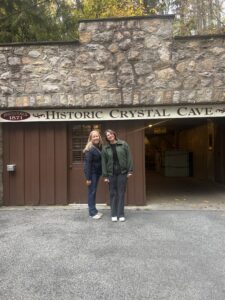
As business expanded, the Kohler family tested the limits of the cave. Hoedowns, weddings, and baptisms took place in the “Crystal Cave Ballroom”, complete with a bar for liquor, live band, and dance floor. Amid renovations and celebrations, David Kohler (son of Samuel) sold Crytal Cave to J. Douglas Kaufman.
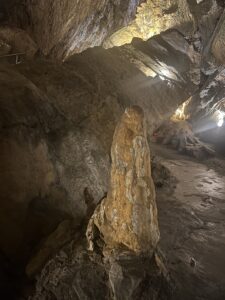
In more recent years, Crystal Cave, Inc. has adapted as an attraction that celebrates nature and educates visitors on the fragility of the cave’s rock formations. When touring the cave, guests are asked to not touch the rock formations, as human touch can interfere with their growth—a big change from the days of removing crystals from the cave as a souvenir.
Now, Crystal Cave attracts the public through their scenic hiking trails, educational group tours, historical museum and much more.
To learn more about Crystal Cave or plan your next excursion, visit Crystal Cave’s website.
The next stop on our tour of Kutztown was to Kutztown University, where the Indigenous Showcase with the Council of Three Rivers American Indian Center participated in a cultural exchange of music, food, dance and literature.
The Council of Three Rivers American Indian Center is a nonprofit whose mission is to promote the socio-economic development of the Native American community and others who experience similar types of economic difficulties in the Greater Pittsburg metropolitan area.
The tribes most associated with Berks County include the Susquehannock, Lenape, and Iroquois peoples. Today, only 1.4% of Berks County’s population identifies as an American Native. The impact of native lives, however, can be found all over the county: what we now know as Maxatawny, Neversink, Saucony, and Tulpehocken were once Machksithanne, Navesink, Saconk, and Tulpewahaki, respectively.
The second day of our Kutztown tour concluded with a brief visit to shops along Main Street and the surrounding Kutztown area. Find the list of shops the foundation team visited below:
- Casa de Empanada
- Saucony Creek Brewing Company
- Sorrelli Jewelry
- Kutztown Tavern
- Young Ones Records
- Paisley & Company
- Dietrich’s Meta’s and Country Store
- Firefly Bookstore
Interested in having the foundation visit your nonprofit or organization? Reach out!