
Not everyone gets to see their parents turn 100 years old, but Berks County Community Foundation does.
This year, Berks County celebrates a remarkable milestone: the 100th anniversary of The Wyomissing Foundation, an institution whose influence reaches far beyond its grantmaking.
Founded in 1926 by Wyomissing Industries visionary leaders, Ferdinand Thun, Henry Janssen and Gustav Oberlaender, the Foundation has spent a century investing not only in organizations, but also in ideas, partnerships, and community assets that continue to enrich the lives of Berks County residents today. While Janssen and Oberlaender ultimately left to start their own foundations (the Gustav Oberlaender Foundation became a fund of the Community Foundation), descendants of Ferdinand Thun continue to serve on the board today.
Perhaps one of the Foundation’s most enduring legacies is its role in creating and nurturing institutions that have become essential parts of Berks County’s civic infrastructure.
The Foundation also helped spark the creation and growth of organizations that have shaped our region’s environmental future. Berks Nature has become a leading advocate for environmental stewardship, conservation, and outdoor education across the county. Likewise, the Schuylkill River Greenways National Heritage Area has transformed how residents and visitors experience one of Pennsylvania’s most important natural resources, preserving history while expanding recreational access and protecting the environment for future generations. They were a founding partner in the effort to establish the Berks Community Health Center, a central part of our effort to approve local health outcomes.
In fact, a list of local organizations who haven’t been strengthened by the Wyomissing Foundation’s efforts would be easier to develop than a list of those who have. There might not be any, and of course, we wouldn’t be on that list.
In 1994, a working group of The Wyomissing Foundation established Berks County Community Foundation. They built the first Board of Directors, provided the seed funding (and credibility) and gave us everything we needed to get started (my first few paychecks even came from the Wyomissing Foundation). It’s an example of an ethos that has marked their work: They put in more than just money; they make investments of intellectual capital and elbow grease.
As we celebrate this extraordinary anniversary, we also celebrate the countless trustees, volunteers, staff members, community partners, and donors who have carried forward the Foundation’s mission across generations. Their collective leadership has helped create a community where philanthropy, civic engagement, and collaboration continue to flourish.
Congratulations to The Wyomissing Foundation on 100 years of service, leadership, and impact. Berks County is stronger because of the vision of your founders and those who helped realize that vision.
Here’s to the next century of catalyzing change.
Nonprofit organizations and educational institutions occasionally change their mission or cease operations. Establishing an endowed fund with a community foundation is one strategy donors can implement to ensure their charitable dollars support the causes they love in perpetuity.
Headlines about college closures, budget deficits, and declining enrollment have become increasingly common. For donors who care deeply about supporting higher education, these stories raise an important question: How can you ensure your charitable gift continues to achieve its intended purpose if the institution you support faces financial challenges or even closes its doors?
In some cases, institutions facing serious financial pressure have sought access to restricted endowment funds to address immediate operational needs. Some have done so with donor consent. Others have pursued legal avenues to modify donor restrictions after the donor’s death. Saint Michael’s College in Vermont, for example, sought court approval to access restricted funds during a financial crisis.
This raises the question: What does it mean for donors when an organization they support raids their endowment?
In a recent Wall Street Journal article, Joanne Florino, Philanthropy Roundtable’s Adam Meyerson Distinguished Fellow in Philanthropic Excellence, discussed the risks that arise when financially distressed colleges turn to restricted endowment funds to meet immediate financial obligations. Although doing so may seem like a short-term solution, it violates donor intent, undermines trust, and can be an early warning sign of deeper institutional decline. Florino points to a scholarship fund that was used to cover expenses at a college that ultimately closed. When the donor later attempted to have the remaining funds transferred to another school so the scholarship could continue serving students, the request was denied.
So, what can a donor do to support the nonprofit, college or university that is important to them without worrying about possible closure, reallocation of funds, or placing the burden of financial management on those organizations?
These challenges highlight the importance of careful charitable planning. Donors who wish to support a specific college, university, or nonprofit organization may want to consider structures that provide long-term protection for their charitable goals. Using a third party to invest and manage an endowment is a way to provide perpetual support for nonprofits. Funds can be managed by commercial financial institutions or a community foundation.
Community foundations across the country provide donors with ways to create endowed funds that support the organizations and causes most meaningful to them. One option is to establish an endowed fund at a community foundation and designate a college, university, or nonprofit as the annual beneficiary. This allows donors to support the organizations they love while ensuring that an independent, charitable steward manages the assets. If circumstances change, such as a merger, closure, or significant change in mission, the fund agreement provides guidance for how the donor’s charitable intent should be honored.
Donors make charitable gifts in the hope that their generosity will make a lasting impact. By working with a community foundation, donors can support the organizations and causes they care about today while creating safeguards that help ensure their charitable intent is honored for generations to come.
At Berks County Community Foundation, our mission is to promote philanthropy and improve the quality of life for the residents of Berks County. We currently steward nearly 400 charitable funds, 290 of which are endowed. Like the endowed funds we manage, the Community Foundation is built to serve the community in perpetuity. As a permanent presence in Berks County, we will continue to honor donors’ charitable wishes, adapt to the community’s evolving needs, and work every day to make Berks County a better place to live, work, and thrive.
Molly McCullough Robbins, Vice President for Philanthropic Services at Berks County Community Foundation, earned the Chartered Advisor in Philanthropy® (CAP®) designation from The American College of Financial Services.
The CAP® designation is a distinguished mark of excellence recognizing expertise in philanthropic and legacy planning, tax strategies, and financial planning related to charitable giving. To earn the CAP® designation, Robbins completed a three-course graduate-level curriculum and accompanying exams to complete each course.
“I’m grateful for the opportunity to continue growing in this field and confident that this knowledge will enhance my work with donors at the Community Foundation—supporting thoughtful, strategic giving that makes a difference in our community now and for generations to come,” says Robbins.
While the CAP® designation from The American College of Financial Services signifies expert knowledge of charitable planning, the course also offers skill development in interpersonal and donor relationships.
“There is no one-size-fits-all in charitable giving: how people choose to give and to whom they give are deeply personal choices. I love participating in that process,” says Robbins. “This experience has deepened my understanding of charitable planning and strengthened my ability to help individuals and families align their philanthropic goals with meaningful impact.”
Prior to her role at the Community Foundation, Robbins spent five years as Executive Director of Wyomissing Area Education Foundation and 10 years as Director of Communications and Assistant to the Director of Advancement for an independent school in the U.S. Virgin Islands.
Robbins completed Berks County Community Foundation’s Nonprofit Management Certificate program in 2020, prior to joining the Community Foundation in her current role. As a Wyomissing Area High School graduate, Robbins’ dedication to the vitality of Berks County is evident.
Interested in working with Molly McCullough Robbins to achieve your philanthropic goals? Email her at mollyr@bccf.org or call the foundation at 610-685-2223.
Welcome to the Great Wealth Transfer!
This much cited era, happening right now, is reportedly the time when trillions of dollars will pass from one generation to the next over the coming decades in various forms, ranging from cash and stock to real estate and business interests.
Understandably, most conversations and commentary about this transfer focus on the assets themselves. Who will inherit the family business? What will happen to the investment portfolio? How should the estate plan be structured? Naturally, those are important questions! But many families are beginning to ask something deeper: “What values do we want to pass along, too?”
A recent Kiplinger article exploring the Great Wealth Transfer makes the point that the strongest family legacies are built not simply by transferring assets, but by intentionally passing along values of generosity through shared charitable experiences and conversations. It encourages families to involve younger generations in philanthropy early, making giving a collaborative, multigenerational experience rather than a one-time financial transaction.
For many people, philanthropy is one of those values. If you’re among them, here’s food for thought:
- A charitable legacy isn’t simply about the gifts that are made after you’re gone. It’s also about helping your children and grandchildren understand why giving has been important throughout your life. In many ways, the conversations, traditions, and shared decisions surrounding philanthropy can become just as meaningful as the inheritance itself.
- Now is a great time to begin mapping out your legacy if you’ve not done so already. For starters, August is widely recognized as Make-A-Will Month, in large part because the downtime of late summer offers a perfect window to address open estate planning issues.
- According to the latest Giving USA report, charitable bequests totaled more than $62 billion in 2025, increasing nearly 20% over the previous year. Bequests were the fastest-growing source of charitable giving, underscoring how important estate gifts have become to nonprofit organizations and the communities they serve.
- A charitable bequest can be surprisingly simple. You might leave a specific dollar amount or a percentage of your estate to your donor-advised fund or designate another type of charitable fund at the Community Foundation, to continue supporting the organizations and community priorities that matter most to you. For example, by naming your children or other loved ones as successor advisors of your donor-advised fund at the Community Foundation, you’re inviting them to continue the family’s tradition of generosity by recommending grants to the organizations and causes they believe will make a difference.
- For individuals and couples with especially large estates, charitable planning also may reduce the federal estate tax ultimately borne by the estate, helping preserve more of the remaining assets for heirs. This consideration applies to relatively few families because the federal estate tax exemption is $15 million per individual in 2026, but when it does apply, it really matters because gifts and bequests to qualified charities generally are deductible in determining the taxable estate. Your attorney, CPA, and financial advisor can help determine whether estate tax planning is relevant to your circumstances.
- Even when estate taxes are not a concern, a charitable bequest can still become one of the most meaningful gifts you make. You may, of course, provide for family members while also supporting the causes and organizations that have mattered throughout your life.
Estate plans are designed to transfer wealth. A charitable legacy has the power to transfer something even more lasting. The Community Foundation would be honored to work with you and your estate planning advisors to arrange charitable bequests, establish a donor-advised or other charitable fund, and build a legacy your family can continue long into the future.
Create your charitable legacy with Berks County Community Foundation today.
Use the email template at the bottom of this post to introduce the Community Foundation to your professional advisors!
The Community Foundation is honored to work with many individuals, families, and businesses who support the causes they love. Their charitable contributions help make Berks County a better place to live. Trusted professional advisors, including attorneys, CPAs, and financial advisors, help donors make important decisions about taxes, investments, estate planning, and family wealth.
All of this is wonderful! There’s one more step to philanthropy, however, that is sometimes overlooked: connecting the dots. But what does ‘connecting the dots’ mean? If you are a donor or fund holder at Berks County Community Foundation, or plan to establish a fund, please consider introducing your advisors to the foundation team. A simple introduction can make a tremendous difference in achieving your charitable goals.
How connecting the dots can help:
- Attorneys, CPAs, and wealth managers are experts in many aspects of financial and estate planning. Their work is essential in helping you develop and implement strategies through legal documentation, tax filings, and other technical guidance. Not all advisors, however, are experts in charitable giving.
- The Community Foundation brings to the table specialized knowledge about local philanthropy. This knowledge can include charitable giving strategies, local nonprofit needs, philanthropic tools that may be best suited for your situation. This knowledge can also inform the types of assets you might consider giving to achieve your goals.
- The Community Foundation also stays current on legal, tax, and charitable developments. In turn, we can keep you and your advisors informed about which trends to watch.
- When you establish a fund at the Community Foundation, our team will handle the paperwork and administration. We will manage and distribute the fund to meet your charitable intent. This is often a relief to your advisors and to you!
Collaborative conversations among donors, professional advisors, and the Community Foundation are not reserved for ultra-high-net-worth families. Even straightforward charitable plans can benefit from collaboration between your advisors and the Community Foundation. In many cases, donors discover giving opportunities they might not otherwise have considered. What’s more is that many advisors appreciate the philanthropic specialists who explore strategies that benefit both the donor and the causes they love.
What can you do? A simple email introducing your advisors to the Community Foundation team opens the door to better communication and stronger planning. The Community Foundation is always happy to have a conversation with you and your advisors, and an introduction is critical. Click the button below to access an email template and get the conversation started!
When professionals work together, the result is often more coordinated and impactful. By connecting your advisors with the Community Foundation, you help create a team that can support both your financial goals and your desire to make a lasting difference. We look forward to hearing from you—and meeting your advisors! Thank you for all you do to make our community a better place.
The fourth issue of our annual magazine, 237 Court, is here.
With each 237 Court magazine publication, the communication team at Berks County Community Foundation evaluates the important work performed by our team of experts and the community; that is the work which inspires the theme of every publication and every story. This year, we’ve observed the resilient nature of Berks County nonprofits through some of the toughest funding cuts in recent history. “A Year of Strengthening Our Roots” is about more than fostering community connections—it is also about digging deep. The stories of impact and captivating images found in this issue of 237 Court magazine are a small sample of the tenacious community leaders, donors, and grantees in Berks.
“Though the Community Foundation was established just 32 years ago—young in comparison to Berks County’s long history—we, too, are built to endure,” says Kevin Murphy, President and CEO of Berks County Community Foundation. “We intend to be here forever, faithfully honoring the charitable wishes of the donors who have entrusted us to carry their legacies forward for generations to come.”
Our mission is to promote philanthropy and improve the quality of life for the residents of Berks County. The team works hard to bring organizations and individuals together for collaboration to spark change in the community. This year’s annual magazine provides detailed stories of these achievements, underscoring the powerful impact of donor support in the community.
To read the full magazine, read the flipbook below or click here.
The word “philanthropy” comes from Greek roots, meaning, quite simply, a love of humanity.
Philanthropy is a big word—but at its heart, it reflects something very personal: the desire to help others, strengthen community, and make a difference in ways that matter to you.
For some people, philanthropy means supporting a favorite nonprofit year after year. For others, it means volunteering time, responding to urgent needs, or thinking carefully about how to create lasting change. However it shows up, philanthropy is not one-size-fits-all. It’s as unique as the people behind it.
That’s where the Community Foundation comes in.
At the foundation, we believe that everyone’s philanthropic instinct looks different, from person to person. Our role is to help you discover, shape, and act on that instinct in a way that reflects your values, your experiences, and your goals. Whether you already have a clear vision or are just beginning to explore what matters most, we’re here to help you connect the dots.
How exactly does this work? What does it look like in real life to get started with the Community Foundation?
Often, the starting point is simply having a conversation. Here’s what you can expect during your first meeting with a member of the team.
We’ll review your favorite charities.
Together, we’ll take a look at a list of the charities you already support and review each organization to uncover the reasons you love and support each one. This is a crucial starting point because the Community Foundation is here to help you make the most of what you are already doing and then build on that to discover how you can get even more involved.
We’ll chat about your story.
We enjoy hearing from our donors about the experiences that have shaped their lives. As we begin this part of our conversation, we’ll explore questions that help unlock where your charitable passions may lie and why. What challenges have you or your loved ones faced? What opportunities made a difference for you? Often, the causes we care about most are connected to our own journeys. Reflecting on these moments can help clarify where you feel most motivated to give.
We’ll talk about what’s going on in our community.
Which local issues capture your attention or spark a strong emotional response? It might be something you read in the news, a local initiative you hear about, or a cause a friend supports. These moments are often clues pointing toward what matters most to you. The foundation can help provide context for these issues and share information about which organizations are directly addressing the local challenges that top your list.
We’ll connect with your advisors about structure.
As your charitable purposes come into focus, we would welcome the opportunity to join you for a meeting with your estate planning and tax advisors, or even provide information you can share with your advisors about charitable giving structures that might help you achieve your goals. Whether your charitable goals are best served via a donor-advised fund, unrestricted fund, legacy gift, IRA beneficiary designation, or anything in between, the Community Foundation can help implement your charitable intentions in ways that your advisors recommend are best aligned with the rest of your financial plan.
As we take these steps together, remember that you don’t have to have all the answers right away. Philanthropy is a journey, not a destination. Whether you’re ready to establish a fund, looking to deepen your involvement, or simply beginning to think about how you want to give back, the Community Foundation is here to help. Together, we can turn your love of humanity into meaningful, lasting impact—right here in the community we share.
Many people are not fully aware of the extent to which charitable organizations shape everyday life in our communities.
From social services to education, healthcare, and the arts, nonprofits touch nearly every aspect of quality of life. Americans give hundreds of billions of dollars to charity each year, supporting roughly 1.9 million organizations nationwide. These organizations often become even more essential during periods of economic uncertainty, when demand for services tends to rise just as resources can feel more constrained.
That dynamic is especially relevant as many are watching the markets closely this spring. Even the possibility of a downturn can influence financial decisions, including charitable giving. It is natural to feel more cautious. At the same time, history shows that community needs often increase during challenging economic periods—making it all the more important to stay engaged in philanthropy.
As you think about your charitable giving this year, this may be a good moment to step back and consider not only where you give, but also how you structure your giving for long-term impact. In particular, it is important for donors and fund holders to consider expanding their portfolio of giving to include giving to the Community Foundation itself. This can take several forms, each of which plays a meaningful role.
Unrestricted giving
Some donors choose to support the Community Foundation’s grantmaking and initiatives across generations. This type of support helps ensure that the foundation can continue serving as a trusted resource—connecting donors to causes, responding to emerging needs, and stewarding charitable funds with care and expertise well into the future. It is an investment not only in today’s giving, but also in the long-term strength of the philanthropic infrastructure in our community.
Support for existing funds
Other donors focus on increasing the Community Foundation’s grantmaking resources so that more money can flow from the Community Foundation to nonprofits that are helping those in need, especially when times are tough. Contributions to unrestricted or broadly focused funds allow the foundation’s program team to respond quickly and thoughtfully to the most pressing challenges facing our region. During periods of economic strain, this flexibility can be especially powerful, enabling support to reach the people and organizations that need it most, at the moment it matters most.
A hybrid approach
In many cases, donors adopt a dual strategy—continuing to support favorite organizations directly or through the Community Foundation’s grant programs while also allocating a portion of their giving to the Community Foundation itself or by establishing a new fund of your own. This approach can help balance personal philanthropic interests with broader community impact, creating a more resilient and adaptable giving strategy.
The Community Foundation’s unique role is what makes any or all of these approaches so effective. As a perpetual institution governed by a local board of directors, Berks County Community Foundation is designed to serve the community not just today, but across generations. Our team maintains deep knowledge of local needs, works closely with nonprofit partners, and is positioned to deploy resources where they can do the greatest good over time.
Especially in moments when the future feels uncertain, expanding your portfolio of giving in this way can provide an added layer of confidence. You can continue supporting the causes you care about while also strengthening the Community Foundation’s ability to lead, respond, and make a difference—now and in the years ahead.
We are honored to work alongside you as you consider how your philanthropy can support both immediate needs and lasting impact for our entire community.
Most of us can think of something we fully intend to do—someday. Organize the photos. Update the estate plan. Schedule the family meeting. Reboot the exercise routine. Charitable planning often falls into that same category.
We hear from many generous people who care deeply about their community and fully intend to “do more” with their philanthropy. But life is busy. The calendar fills up. Markets fluctuate. Family and business priorities shift. It can feel easier to wait for the perfect moment—when things feel calmer, clearer, or more certain.
If that sounds familiar, you are not alone. And it is not a sign of indifference. More often, it reflects uncertainty.
You may wonder:
- –Am I giving to the right organizations?
- –Am I committing too much too soon?
- –What if my priorities change?
- –What if I want to involve my children later?
When every decision feels permanent, it is natural to pause. The Community Foundation can help you shift gears from intention to action. Here are three principles that guide our work with donors in this situation:
Take it one step at a time.
One of the most helpful mental shifts is to think of charitable planning as a multi-step process rather than a single, all-or-nothing decision. In many cases, a tax planning need takes precedence because of concrete deadlines and tax year considerations. Our team understands!
Keep it simple.
Sometimes the hardest part of giving is not generosity—it is decision fatigue. You might be asking yourself, “Where should I give?” Often, that’s not the best question to ask right out of the gate, especially if you are new to philanthropy. The team at the Community Foundation can help you work through key threshold questions including:
- –As I look back on my charitable giving, what areas of focus seem to jump out?
- –What specific charities have I supported over the years?
- –Why have I supported those charities?
- –Is there anything about my areas of focus that I’d like to change going forward?
As we explore these questions together, our team can provide research on local nonprofits, share insights about community needs, and facilitate family conversations about values and priorities.
Adopt long-term thinking.
Community change does not happen overnight. You may find that your charitable intentions include not only providing annual support to favorite charities but also making a meaningful difference over many years or even many decades that extend well beyond your lifetime.
The team at the Community Foundation can help you structure not only a donor-advised fund to help organize your annual giving, but also other types of funds and a legacy plan. Some families, for example, establish a field-of-interest fund to support a particular cause with built-in flexibility as community needs change. Similarly, a designated fund can provide long-term support to specific organizations, and an unrestricted fund allows you to leverage the Community Foundation’s deep expertise and perpetual structure to address emerging community priorities for generations to come. You can name one or more of these funds as a beneficiary in your estate plan, whether through a gift in your will or trust or through a beneficiary designation on an IRA.
The bottom line is that the Community Foundation is here for you along your entire charitable giving journey. We’ll work together to build and implement your philanthropy plan brick by brick over the years to come, involving your tax advisors and family members at key junctures and always ensuring that your charitable intentions—even as they evolve over time—are fulfilled.
Our 2025 Annual Report: A Year of Connection is here
In Fiscal Year 2025, Berks County Community Foundation distributed over $6.8 million in grants and scholarships to support the community. While grantmaking is “what we do,” connecting to the community is at the heart of our work.
Berks County Community Foundation connects donors, grantees, and community partners to one another in the pursuit of the greater good. Our Program Team, comprised of experts in their fields of interest, made quarterly site visits to local institutions to learn about their operations, needs, and impact on Berks County. During the federal government shut down and Pennsylvania state budget impasse, the communication and program team engaged a local reporter to investigate how government cuts affect Berks nonprofits. Connecting with people, sharing expertise, and learning from one another, is how communities thrive.
“While distributing grants and scholarships is a core part of our mission,” says Kevin Murphy, President and CEO of Berks County Community Foundation, “none of our work would be possible without the relationships we build throughout Berks County.”
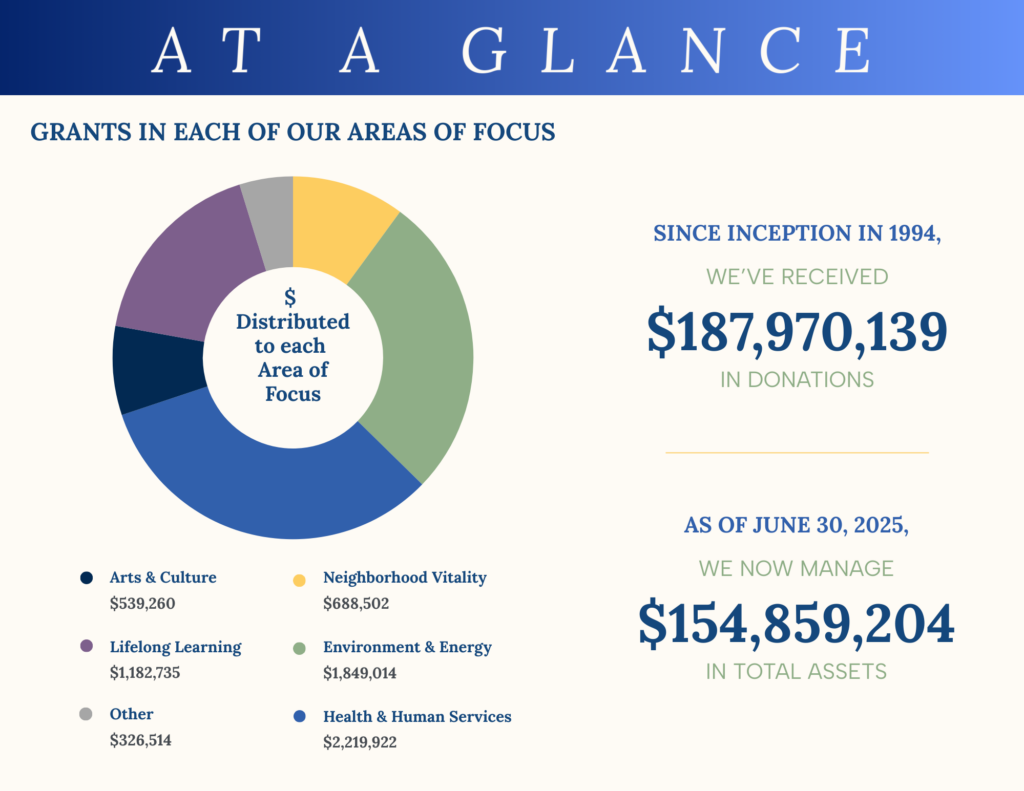
The Annual Report highlights our mission of promoting philanthropy and improving the quality of life for the residents of Berks County. The team works hard to bring organizations and individuals together for collaboration to spark change in the community. This year’s Annual Report provides detailed stories and data behind these achievements, underscoring the powerful impact of donor support in the community.
To read the full report, take a look below or click here.
